Monday, 25 July 2016

The way through my PhD, and how I managed to get to my defense

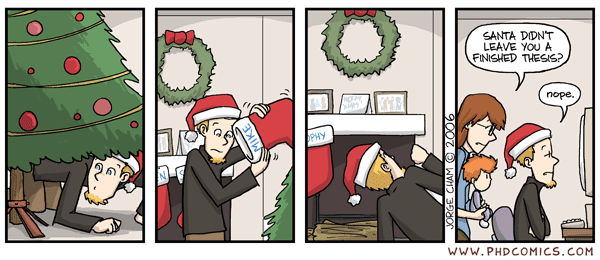
That moment that I've been working towards for so long, it's finally here! Just over 2 weeks ago, I successfully defended my PhD thesis. I'm only a few minor corrections away from officially being a Dr. - yay! But let's go back and see how I got here. I'll follow up and tell you about the actual defense in the next post, so stay tuned!
After a bunch of applications and preparation, I started my PhD at UBC in Vancouver in September 2011. The anticipated time to do a PhD at UBC is 4 years, but most people that I know have taken a bit more than that, usually 4.5-5 years. Taking into account my 4-months leave last summer, I managed to fall pretty much exactly into that time frame. 

The first couple of years were quite "slow", meaning that I didn't make tons of research progress. This is quite normal, it took some time to get my bearings in a new city and at a new university, I took some classes, my supervisor was on sabbatical for a year, and we spend some time trying to figure out what exactly I would work on. 

Once we had the details of the project narrowed down, I took my "candidacy exam". The main step was to write a proposal for my work, and then have a "mini-defense" in front of my supervisory committee. This exam exists so they can determine whether I would advance from PhD student to PhD candidate - a first stamp of approval that says, "Yes, we think she will be capable of doing the work and successful in her PhD". Around this time, my supervisor and I agreed that I should have at least three publications in order to finish my degree.

The pace picked up a bit in my third year, when we spent quite some time writing my first publication. It was a slower process than I expected, partly because I had only written a publication with my Master's supervisor, and my PhD supervisor and I needed to work out how to align our writing styles, our ways of thinking, etc. It was really good to do this waaaay before I was due to write my actual thesis, I imagine the thesis would have been quite a big effort otherwise.

In my fourth year, I thought I had a plan and was on schedule to finish by summer 2016 without a huge rush. Of course, the way these things go, the plan fell through and I went on leave for an internship, knowing that I would only have two semesters left when getting back to UBC, and still having to do a TON of research, and write up two publications about said research. 

Those last two semesters, the end of my fourth and beginning of my fifth year were a crazy, crazy time. I spent most of my waking hours trying to get the research done as soon as possible, and at least have my second paper accepted, if not published by the time my thesis needed to be submitted. In addition, I had chosen to move to the UK more or less permanently during that time, so I also had to organize my move and all sorts of logistical issues. 

That second paper took its sweet time, but was finally accepted just a couple of weeks before my thesis was due. Because the revisions for this publication had taken so long, there wasn't much time for paper number 3. Within about three weeks in early-mid April of this year, I churned out my last publication, and managed to get it into a submittable state just in time. We submitted the thesis and the paper a day ahead of schedule, set a date for my defense, took care of all the logistics, and the following weeks were amazingly free of worries and work. 

I'll talk more about the actual defense next time, but for now I want to finish with four take-home points, that will hopefully help you, as a PhD or other graduate student, to focus on what's important and stay on schedule. If you're not in grad school and have no intention of every going down that route, then maybe at least with this post you will have gotten a glimpse into my life for the last few months and years, and forgive me for neglecting my blog or friends for a while here and there.
So here's the gist:
  1. Don't worry, if things seem to be progressing quite slowly in the beginning (or almost up to the end). Most people I know did almost all of their really productive work in their last year.
  2. Have clear goals set from the start, and make sure you're on the same page as your supervisor (having 3 publications was the goal in my case). That way it's easy for you to check in on the way and decide when to call it a day.
  3. Have a plan, but be prepared for things to go wrong - because they will. Inevitably.
  4. Try to publish as much as you can on the way, if your university allows it, and use those publications in your thesis. That way you'll have parts of your thesis written way before you're actually thinking about sitting down to write that dissertation.
This last item turned out to be quite important for my defense, as we will see next time...


Tuesday, 26 April 2016

Science journalism - Or how I met Jonathan Amos

Last week, I was in Vienna for the General Assembly of the European Geosciences Union (EGU). Every year, more than 10,000 geoscientists come together in this beautiful city on the banks of the Danube and discuss their latest research results. Along with the scientists, educators, teachers, and policy makers, journalists join the party and report some of the most interesting, surprising, or groundbreaking scientific findings. For the first time, EGU launched a student reporter programme this year. There were five of us students who got to report on aspects of the meeting for some of the EGU division blogs (check out my posts for the EGU Cryosphere Blog here). One of the perks of our reporter status was that we got access to the press office, where I had the chance to have a chat with Jonathan Amos, science correspondent for the BBC.

Jonathan - originally from Bristol, my new home - has been working for the BBC since the mid 90s, but as it turns out he also has a background in science. Originally trained in sociology, he decided to take distance courses at the Open University to learn more about different scientific disciplines after having started working as a reporter. His continuous interest in science is very evident in his reporting, and among other he has been awarded with the prestigious Sir Arthur Clarke Award.

Jonathan's profile on the BBC homepage. I had no idea that he is from Bristol!

As someone who has acquired most of her science communication experience in North America, I was curious about Jonathan's opinion on differences in terms of science journalism on different sides of the Atlantic. Initially, his answer was that he can't think of any fundamental differences. However, when we kept talking about the issue he mentioned that from his view it seems like many science events in North America (such as the American Geophysical Union Fall Meeting in San Francisco) do not get covered by the big US television networks. I never noticed that! This issue would probably be relatively easy to fix, and might help with some of polarization the US population is experiencing in terms of whether or not scientific facts are understood and accepted by the general public. 

Related to improving the way scientists communicate with the public, Jonathan made an interesting comment. As a scientist I sometimes read articles in the newspaper and get a bit dissatisfied with the use of some scientific terms. Viewed from a journalistic perspective, however, sometimes scientific accuracy might be less important than using a term that gets the concept across to a reader, in a way where they can relate to the idea with something they are familiar with. Jonathan's example was the term "regolith", which is used to describe the outermost layer of the moon. Even though there is definitely no soil in the scientific definition on the moon, using the term "soil" when we talk about regolith helps to convey the idea that regolith is often quite lose and broken up. I have to agree that using slightly inaccurate analogies might sometimes be good to convey a message. However, many misconceptions about scientific facts come from the use of such analogies. For example, during my outreach visits to schools I've encountered more than one teacher who believe the Earth's mantle is molten. The mantle does "flow" over time periods of many thousands or even millions of years, but there is only a very small amount of actual melt. If teachers have misconceptions about science, these will be passed on to our children, so if science concepts are simplified too much we risk misunderstanding. In the case of "regolith" and other specific terms I think the best option might be to use the term, but explain it properly when it's used the first time. What do you think?

Viewing the conference, geosciences, and science communication from the perspective of a journalist was definitely a unique experience, and one that I wouldn't want to miss. From what I've seen in the press office last week things can get pretty hectic, so I appreciate that Jonathan took the time to sit down with me and answer all my questions. At the end of my interview he told me that he likes to ride his bike, so keep an eye out and maybe you'll see him whizzing past on his way to the next interview...

Monday, 15 February 2016

Please hold

Dear beloved readership, with no doubt you will have noticed that it's been eerily quiet on these pages lately. I am in the process of finishing up my PhD thesis, and I desperately need the few minutes every week that aren't occupied with data analysis, writing, eating, or sleeping to get away from my computer, to go outside, or to the gym to get rid of some of the tension that builds up during the rest of the day. Unfortunately that means that I will put this blog on hold for the next few months. Hopefully at some point this summer, I will be back with good news. In the meantime, I hope that you will find other volcano- and science-y online resources, and that my absence won't stretch your patience too much. Wait for me on the other side!

Wednesday, 25 November 2015

A volcano lover's gift guide

Once again, it is that time of the year - when the smell of baked goods and mulled wine floats through the air, jingly music comes from a speaker somewhere, and you can hear the crackling of a fire and the roar of a volcano... uh, what?
Just as to any volcano lover, volcano-y gifts are the icing on the holiday cake to me. So I thought I'd put together a list of awesome volcano-related gift ideas*, and share them with you. If you're not interested in gifts, but would like the take a super quick survey about science blogging, go ahead and scroll to the end.


  1. Based on my personal experience, volcano-lovers more often than not also love games. Why not give them a deck of Volcano Top Trump cards? Guaranteed volcano-battling-fun for all ages, and awesome for your bank account too - they come for only £4.99 (distributed through the University of Plymouth, click here)!
  2. For those who are more passive admirers than active players, a volcano calendar might be just the right thing. Pleasing to the eye, fascinating to the scientifically curious mind, and delivering a little bit of (imaginary) heat to any living room, volcano calendars are awesome because your volcano-inclined friend needs a new one every year! They usually come at a reasonable price, have all sorts of shapes and sizes, and may come with captions in different languages. They even come in your favourite currency! One example for €17 can be ordered here, or another one for $17.99 here.
  3. Going back to games, just because most of us have their inner child available somewhere. Did you know that my favourite board game of all times, Settlers of Catan, comes with an optional volcano tile?? This highly exciting variation of the game promises to add just the right level of excitement for all the risk takers among us. Apparently it can be bought as part of the Atlantis Scenario Extension (only in German, as far as I'm aware), or if you're looking for a cheaper option you can simply download and print the volcano tile from here.
  4. Feeling slightly cheeky? I highly recommend a selection of volcano-y movies for the not so serious volcano-phile. Among my all-time favourites are of course Dante's Peak (Pierce Brosnan), Volcano (Tommy Lee Jones), and the original Journey to the Center of the Earth (admittedly only somewhat volcano-related). One that I haven't seen but might add to my list is St. Helens, and one that I definitely would not recommend at all is Pompeii. But that's just me... Once you've picked your candidate, you can just buy a DVD if you want a simple present, or design a whole evening around a home screening of your volcano movie of choice. Maybe even accompanied by a freshly baked lava cake?
  5. Speaking of lava cake. A mouthwatering chocolate lava cake says more than a thousand words. I haven't tested this particular recipe, but it sounds temptingly simple.
  6. If you accidentally left your chocolate lava cake in the oven for too long, do not despair! You can always leave it in a bit longer and later gift it as a beautiful volcanic rock sample, with your own description of formation added... If you'd rather go the conventional route, a nice piece of volcanic rock from a volcano of your choice will let any semi-serious geo-enthusiast's heart beat faster. Volcanic rocks can be incredibly diverse and astonishingly beautiful. If you don't have a volcano as a source for your rock gifts in your backyard, you could order some rock kits that include igneous (= volcanic rocks from above and below the surface) samples here or here. Of course, if you found the sample yourself, you can add a little description with your story that goes with it. And maybe you were lucky enough to find a snowflake obsidian, or one of those beautiful banded, glassy volcanic rhyolites?
  7. While we're talking about geosciences: Somebody more interested in practical gifts and with a knack for popular science might enjoy a digital edition of a magazine themed around volcanoes. You can order a (German) digital collection about volcanoes and earthquakes by Spektrum der Wissenschaft for €4.99 here, or maybe Alex Witze's book about the Laki eruption in Iceland in 1783?
  8. On the topic of books: John Mullan at The Guardian put together this list of volcano-related fiction books. Even though I would question the appearance of Lord of the Rings on the list, overall it sounds like some of the suggestions might be really good reads! Or if you're looking for something for a little one, maybe this list by Jenni Barclay over at the University of East Anglia will give you some inspiration.
  9. Know someone who isn't too shy to display their volcano enthusiasm? Surprise them with a volcano-y piece of clothing! There are these cool looking (but somewhat pricey) volcano hoodies/sweaters/tank tops, or some cute handmade volcano and dinosaur onesies, or even a volcano-print catsuit!
  10. Last but not least, the crown jewel of volcano gifts - probably somewhat out of most people's regular holiday price range... a trip to a volcano! If you're in Europe you might want to go to Stromboli (Italy) to see its fireworks, if you're in North or South America maybe a trip to Popocatepetl or Colima (Mexico) to spot their ash clouds, from Asia you could hop over to Sakurajima (Japan) to see its almost daily explosions, if you find yourself in Oceania take the plane/boat/helicopter to White Island (New Zealand) to see some phreatic (= water/steam related) eruptions, or if for some magical reason you happen to be in Antarctica you could try to get a view into the lava lake at Erebus Volcano. So many options, not enough time (or money).
Hopefully I've managed to inspire your imagination and give you lots of awesome volcano-y gift ideas. Obviously there are lots of possibilities, so if you think of something amazing that I didn't mention feel free to comment or shoot me a message.


Lastly, I've teamed up with Science Borealis, Dr. Paige Jarreau from Louisiana State University and 20 other Canadian science bloggers, to conduct a broad survey of Canadian science blog readers. Together we are trying to find out who reads science blogs in Canada, where they come from, whether Canadian-specific content is important to them and where they go for trustworthy, accurate science news and information. Your feedback will also help me learn more about my own blog readers. 

It only take 5 minutes to complete the survey. Please, please, please, take the survey here: http://bit.ly/ScienceBorealisSurvey

If you complete the survey you will be entered to win one of eleven prizes! A $50 Chapters Gift Card, a $20 surprise gift card, 3 Science Borealis T-shirts and 6 Surprise Gifts! PLUS everyone who completes the survey will receive a free hi-resolution science photograph from Paige's Photography! 

This is one of the photos I got :)
Credit: Paige Jarreau

*Disclaimer: I am not affiliated with any of the vendors, nor do I make any profit by writing this list. I just like volcanoes :)


Sunday, 25 October 2015

Like a box of chocolates

Sometimes studying volcanoes is similar to what Forrest Gump told us about life: You never know what you're gonna get.
Yesterday we had our Vancouver Volcano Studies Group meeting. Basically, this group consists of a bunch of people in Vancouver doing volcano related research, or people who are just somehow affiliated with one of us and interested in the topic. This time, we decided to have a once-a-term mini-conference. A bunch of us gave talks about our volcano-y research, and I was pretty blown away. I mean, I'm a volcanologist, so surely I know about most of the methods we use to study volcanoes, right? Incorrect. There are so many cool ways we can study volcanoes that people talked about yesterday, it was really fascinating. And the best part? Some methods can be done by anyone! Citizen scientists, we need you!
So let me give you some examples.

  1. Drones! This is of course a buzz word at the moment, but turns out they can really help us to learn about our volcanic neighbours. Drones are good, because they don't care too much if a volcano erupts a bunch of gases that might not be great for human health - at least if you don't leave the drone sitting in those gases for days or weeks at a time. Also, with drones we can cover a lot of ground in a short amount of time, and get to see places that otherwise we might never get to. That means we can fly a drone over a lava lake, or some other potentially dangerous part of the volcano, and get video footage without having to risk our lives. Yay! You can also mount all sorts of cool equipment on a drone, depending on how big the equipment is and how strong/stable the drone is. I'm thinking, maybe small gas sensors, or a thermal camera? 
  2. Lasers! Ok, this sounds tacky, but seriously. There is a technique called "Lidar", which means you shoot a laser pulse at something, it bounces off, comes back to your sensor, and you can measure the time it takes, and maybe some other things about the returning pulse. We can cover whole areas with those Lidar measurements, and that way reconstruct the surface that we were scanning, in 3D! Certain properties about the returning waves might even give us some information about the material we were scanning. That means, without having to go there, we can scan surfaces and observe how they are changing over time. For example, we can learn about lava lake explosions when rocks fall into the lake from the walls. How? We measure the volume of rock lost into a lava lake in a rock fall, by comparing the Lidar scans from before and after, and we can of course measure the height of the explosion from the lava lake, or some other property. That way we can learn about potential processes happening underneath the surface of the lava lake during the rock fall, or at the very least we can know for next time when a rock fall happens how big the explosion might get.
  3. This is maybe the coolest one, cause it's so simple that anyone can do it: Photos! If you take lots of photos of the same object from different angles, there is software that can create a 3D image of your object. That way we can get detailed models of areas that are too difficult or too dangerous to get to, just like with drones. Even better if we can combine the two somehow, drones and photos. We could study the surfaces of the rock on a high peak, for example, and learn about how they formed, or we could get the change of time of the surface of a growing lava dome at really high detail - maybe this can tell us when a collapse of the dome may be happening soon? Of course there are lots of calculations and conditions that need to be met for this to work, but in theory anybody could do this! If you're an avid climber or mountaineer, you might be able to help us study some of the old volcanic peaks by taken photographs of them from certain angles during your trips, and submitting them to some sort of central repository afterwards - so you get to contribute to science while doing your favourite outdoor activities, isn't that cool?!
I realized during the meeting that this kind of thing happens quite often: I go to a meeting or conference, expecting the standard presentations, and then get something completely unexpected, new, and exciting! To me, it was most surprising to see how simple some of the concepts are, and yet how useful they might be to learn things about volcanoes! Sometimes, the best ideas are the really simple ones.

Monday, 20 July 2015

Volcanoes in Ecuador

Last November I participated in a workshop on volcanic unrest, where we spent several days discussing possible tell tale signs that a volcano might be waking up, and whether or not we can use these signs to know whether it is going to erupt or whether it's just stirring a bit before it's going back to sleep. Turns out that knowing for sure is actually quite difficult!
We also got a chance to do an eruption simulation, where we were fed fake monitoring data and were supposed to make decisions about advice to local authorities and emergency management along the way.
From a science perspective the workshop was interesting, but what I think was most valuable (and is often overlooked) is how it brought together scientists, civil defense and emergency management professionals, monitoring organizations, and local (political) authorities. Communication between these different entities is crucial particularly in crisis situations around natural disasters, but can't function properly if it hasn't been establish long before an actual emergency occurs. Every scientific project with a natural disasters component should include all of these groups!
Last but not least, of course we visited two of the local volcanoes, Cotopaxi and Tungurahua. Neither of them were in eruption at the time, but both of them presented majestic sights.
Below a video from the VUELCO project, that summarizes our experience.


Monday, 22 June 2015

Disaster preparedness - Plan, pack, proof

Natural disasters can strike pretty much anywhere and anytime. I'm not just talking about volcanic eruptions, but anything from flooding through wind to earthquakes, landslides, and more. I have never lived in a place that was 100% free from natural disasters, and probably never will. Neither do you. 

When I was in southern Germany, we got thunderstorms, hail, and crazy rain that can lead to flooding, especially in the plains at the foot of the European Alps. In the mountains themselves, landslides and rockfalls are not unheard of. In New Zealand, we had earthquakes, volcanic eruptions, storms, and even the odd tsunami alert from earthquakes happening far away. In BC, volcanoes are only a smaller problem, but (potentially large) earthquakes can happen. Whereas the West coast of Vancouver Island may get hit by Tsunamis, Vancouver is relatively sheltered. Winter storms can still hit pretty badly. I recently did a temporary move to Houston, Texas. If you've been following some US news I'm sure you heard/read about the Memorial Day flooding we've had down there. Tropical storm Bill, which followed a couple weeks later, was relatively harmless, thankfully, but Hurricane season has just started and we don't yet know what it will bring. The storm, however, got me thinking once again about being prepared for natural disasters.

Even though we may have little or no warning of what's coming our way (depending on whether we're talking weather, volcanic eruptions, or earthquakes, for example), there are definitely ways in which we can at least try to soften the impact natural disasters have on our lives. Of course, my German-ness makes me biased - after I all I love planning things, but in this particular case we could all benefit from some small preventative measures. The type of preparation might change depending on what kind of natural disasters your region is prone to, but some things are the same no matter whether you live in a volcanic area or somewhere with blizzards dumping snow on you. There are two important things to keep in mind:

  1. Come up with a plan well in advance. Whereas with a hurricane we might get a few days warning ahead of time, earthquakes unfortunately don't do us favours like that. We want to be ready when disaster strikes, and it will only take maybe an afternoon to come up with the basics.
  2. Most of your planning will not go into the logistics for the actual event, but mostly the aftermath - when power and water might be gone, infrastructure might be damaged, shops closed, and when we might have to be self-sustained for a number of days.


So that being said, here are some simple things that you can do to reduce the damage a natural disaster might do to your home, belongings, and loved ones.

Phase 1: Plan

Educate yourself about natural disasters that might happen in your area. Geologic surveys, met offices, and other (potentially government run) organizations and their websites are great resources. Work your way down from large to small: What natural disasters occur in my part of the world? How would my town be affected? My neighbourhood? My house? My commute? My workplace? My kids' school? For example, you might live in an area where flash flooding can occur after heavy rain, but your house is on top of a hill, in which case you would not necessarily have to be super worried about large amounts of water accumulating in or around your house. Or you may live in an earthquake prone region, and your house might be on top of sand or gravel type sediments, in which case the shaking from an earthquake might be worse than if the building was on a thick, stable granite. Knowing what could happen can win you half the battle. Below an example of an earthquake hazard map for Victoria, BC, from the Ministry of Energy and Mines. Similar resources might also be available in public libraries.

Relative earthquake hazard map for Victoria, BC. Monahan et al, 2000, from Ministry of Energy and Mines (http://www.empr.gov.bc.ca/Mining/Geoscience/NaturalHazards/VictoriaEarthquakeMaps/composite/Pages/default.aspx)

Furthermore, come up with a plan for your family. How are family members going to get in touch in case of a disaster? Is there somebody outside the area who could serve as a check-in point? What if the event occurs when you are at work/school? What if it's at night? Do you have a pet that needs extra consideration? Make sure everyone is aware of the hazards and knows what to do. Again, there are some amazing online resources that make coming up with a plan really easy.

Phase 2: Pack

Once you know the potential natural disasters and their impacts, pack an emergency kit. Imagine being without water/power/outside help for several days. You will need enough water for everyone in the house, dry/canned food, medications, first aid, flashlights, spare batteries, cell phones and chargers (ideally with portable power sources), some tools and/or an army knife, your most important documents such as passports, some blankets, warm/waterproof clothes, and so on. Having documents in a waterproof case/envelope might be useful. Some extra items like sleeping bags, or your children's favourites toys could be a good idea too. Make sure everything is in one, easily accessible place, and everyone knows where that is. If you don't want to assemble a kit yourself, you can even buy them online! Be sure to change water/food/medication every few months so that nothing is out of date. And again, having everything ready well before a natural disaster occurs is crucial - when I went to the supermarket the night before Bill was supposed to make landfall they were almost out of bottled water, and canned food was running quite low too.

Phase 3: Proof

Last but not least, try to proof your house for the potential event. For example, in earthquake regions you could move heavy items to the bottom of shelves instead of the top, to avoid heavy objects such as books tumbling down and injuring people. Or, in regions along hurricane paths it might be useful to always secure or limit the number of loose items in the backyard/on your balcony, outdoor shutters, and more. It all depends on the type of natural disaster happening in your area.


That doesn't sound so difficult, does it? By doing all this you won't be able to reduce the hazard (i.e. the potential for natural disasters) to your particular area, but at least you have done everything in your power to lower the risk (i.e. your vulnerability to the existing hazards). In the grand scheme of things, it doesn't take long, it doesn't cost much, but it might make your life a lot easier in case something really does happen! Stay safe!